Introducción a los tipos de PLC
Controladores lógicos programables (PLC) son componentes esenciales en la automatización industrial, Proporcionar un control fiable sobre maquinaria y procesos.. Comprender los diferentes tipos de PLC es fundamental para seleccionar el que mejor se adapte a sus necesidades de automatización.. Las tres categorías principales de PLC son modulares., Compacto, e Integrado. Cada tipo tiene características de diseño y funcionalidades únicas que los hacen adecuados para diversas aplicaciones..
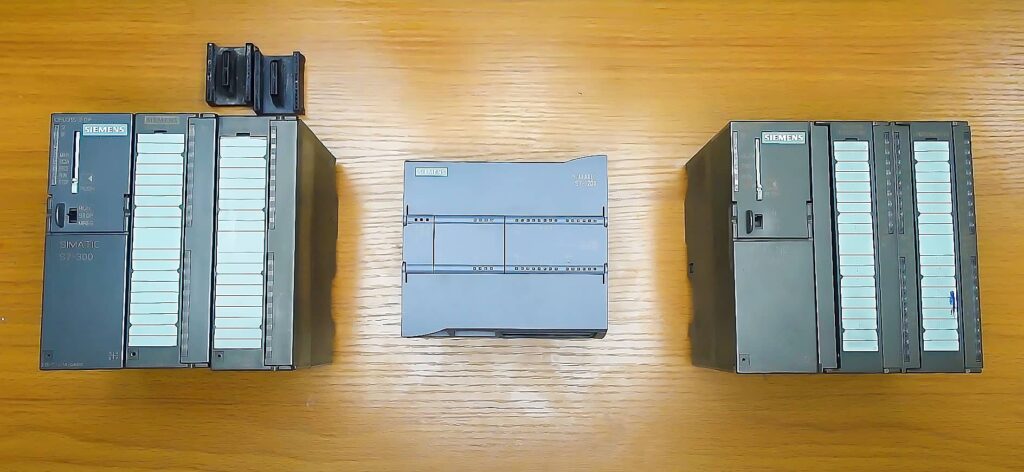
PLC MODULARES COMPACTOS E INTEGRADOS
1. PLC modular
¿Qué es un PLC modular??
Un PLC modular consta de componentes separados que se pueden conectar o reemplazar individualmente. Los componentes clave incluyen el UPC y otros módulos de funciones como Entrada digital (DE), Salida digital (HACER), y Salida analógica (HACIA) módulos.
Características clave:
-
La CPU y los módulos son separables.
-
Los módulos se conectan mediante un conector de bus.
-
Ofrece flexibilidad para agregar o eliminar módulos según sea necesario
-
Puede actuar como PLC modular y compacto según la configuración.
Cómo funciona:
Para montar un PLC modular, la CPU está conectada a módulos individuales (DE, HACER, HACIA) usando un conector de bus. Esto ofrece personalización y escalabilidad., permitiendo a los usuarios agregar módulos simplemente conectándolos a través del conector de bus sin dificultad.
2. PLC compacto
¿Qué es un PLC compacto??
Un PLC compacto integra la CPU y los módulos de E/S en una sola unidad. Está diseñado para ser más ágil y ahorrar espacio en comparación con los PLC modulares..
Características clave:
-
La CPU está alojada en el mismo cuerpo que los módulos de entrada/salida.
-
Contiene DI, HACER, y módulos AO integrados
-
Normalmente se utiliza en pequeños, aplicaciones de automatización menos complejas
Ventajas:
3. PLC integrado
¿Qué es un PLC integrado??
A primera vista, Los PLC integrados pueden parecer similares a los PLC modulares; sin embargo, Los PLC integrados tienen componentes inseparables, Se distinguen por su diseño fijo..
Características clave:
-
CPU y módulos son inseparables (configuración fija)
-
Diseño compacto con capacidad de expansión limitada
-
A menudo se utiliza en aplicaciones donde se requiere una personalización mínima.
4. Resumen de comparación
| Característica |
PLC modular |
PLC compacto |
PLC integrado |
| UPC & Módulos |
Separable |
en el mismo cuerpo |
Inseparable |
| Ampliabilidad |
Alto (agregar/eliminar módulos) |
Limitado |
Muy limitado |
| Complejidad de instalación |
Moderado (conectores de bus de cableado) |
Bajo (unidad única) |
muy bajo (unidad fija) |
| Aplicaciones típicas |
Sistemas complejos/personalizados |
Complejidad media |
Aplicaciones simples/fijas |
Pensamientos finales
La elección del tipo de PLC correcto depende del complejidad del sistema de automatización, presupuesto, espacio, y necesidades futuras de expansión:
-
PLC modulares → proporcionar la mayor flexibilidad y escalabilidad, ideal para sistemas complejos.
-
PLC compactos → ofrecer una solución equilibrada para aplicaciones de tamaño mediano con espacio limitado.
-
PLC integrados → más adecuado para sistemas simples y fijos, donde la capacidad de ampliación y la personalización no son prioridades.
Comprender estas distinciones ayuda a los ingenieros y técnicos a seleccionar el sistema de control más eficaz y eficiente para sus proyectos específicos de automatización industrial..

 por
por