Servomotor
A servomotor is a specialized rotary or linear actuator engineered for precise control of position, velocity, and acceleration in a mechanical system. Unlike a standard motor that simply spins when powered, a servomotor is part of a closed-loop control system: it continuously monitors its own movement and adjusts in real time to match the commanded position or speed.
In practical terms, a servomotor lets you:
- Set an exact angular or linear position and hold it reliably
- Control velocity smoothly across a defined range
- Manage acceleration and deceleration to protect mechanics and improve accuracy
Because of this precision and responsiveness, servo motors are the backbone of robotics, CNC machines, packaging lines, industrial automation, and advanced motion control worldwide. For any application where accuracy, repeatability, and fast response are non‑negotiable, a servomotor is the professional choice.
What is a Servo Motor: Definition, Origins, Components
A servo motor (servomotor) is a type of electric motor built for precise control of position, speed, and acceleration, either in rotary (spinning) or linear (straight-line) motion. Unlike a standard motor that just spins when powered, a servo motor is part of a closed-loop system: it constantly checks where it is and corrects itself to match the target position.
Where servo motors came from
Servo technology grew out of early automatic control systems used in radar, aerospace, CNC machines, and robotics. As industries pushed for higher accuracy and faster response, servo motors replaced simple motors in applications where every degree or millimeter matters. Today, you’ll see them everywhere from robot arms to CNC automation and packaging lines.
Main components of a servo motor
A typical servo motor system includes:
- Motor (AC or DC) – generates the torque or force.
- Feedback device (encoder or resolver) – measures the exact position and speed of the shaft.
- Servo drive / amplifier – reads the feedback and adjusts power to the motor in real time.
- Controller (PLC, CNC, or motion controller) – sends commands like position, angle, or speed setpoints.
In high-end automation, servo motors often work alongside inverters and drives, such as a Mitsubishi inverter FR‑E720 or Yaskawa inverter CIMR series, to deliver efficient, reliable motion control in demanding industrial environments.
What is a Servo Motor and How it Works
A servo motor is a specialized motor built for precise motion control. In simple terms, it doesn’t just spin like a normal motor – it moves to an exact position, at a set speed, and with controlled acceleration, then holds that position firmly.
Here’s how a servo motor works in practice:
- Motor – The electric motor provides the rotation or linear motion.
- Feedback device (encoder or resolver) – This constantly measures the shaft position and speed and sends that data back. High‑precision industrial automation encoders are commonly used here.
- Controller + driver (servo drive) – This compares the target position with the actual position and adjusts the motor current in real time to fix any error.
- Closed-loop control – Because of this feedback loop, the servo can move to, say, 30.5° or 120 mm, stop exactly there, and keep it steady even under load.
That’s why servo motors are the go‑to choice in CNC machines, robots, and industrial automation, where accurate, repeatable movement is non‑negotiable.
Servos Explained
Servo motor simple definition
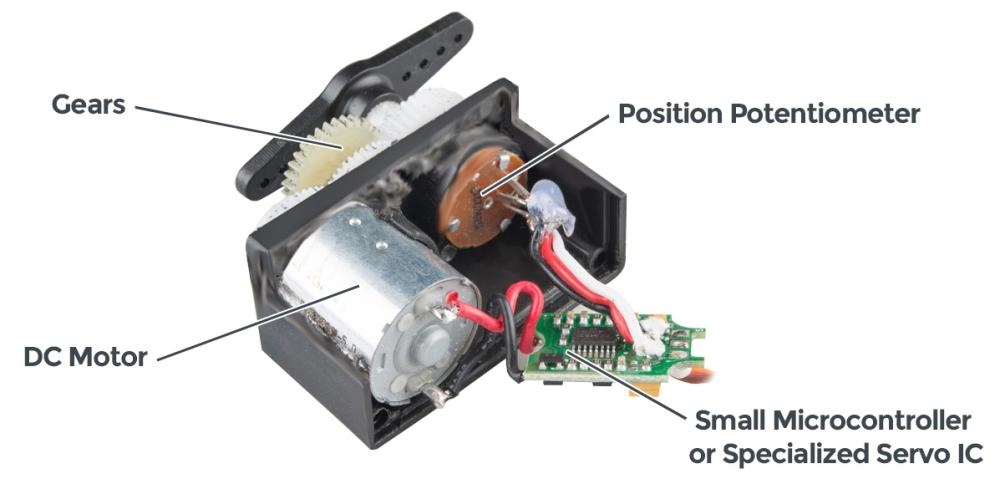
A servo (or servo motor) is a small motor with built‑in electronics and a sensor that lets you control exactly how far and how fast it turns. Instead of just spinning freely like a normal DC motor, a servo motor moves to a specific angle (for example 0° to 180°) and holds that position.
In practice, this means you can:
- Set a precise rotation angle (e.g. 39°) and the servo will move there and stop.
- Hold position under load, useful for arms, levers, and joints.
- Control motion with simple signals from a microcontroller, PLC, or CNC system.
That’s why servo motors are a go‑to choice in robotics, CNC machines, RC planes, camera gimbals, and any project where position accuracy matters. For industrial applications needing higher torque and precision, we typically move to AC servo systems, such as Fanuc α series medium inertia, high torque AC servo motors used in CNC machines and automation lines, which you can see in detail in the Fanuc AC servo motor specifications.
Servo Motor Fundamentals
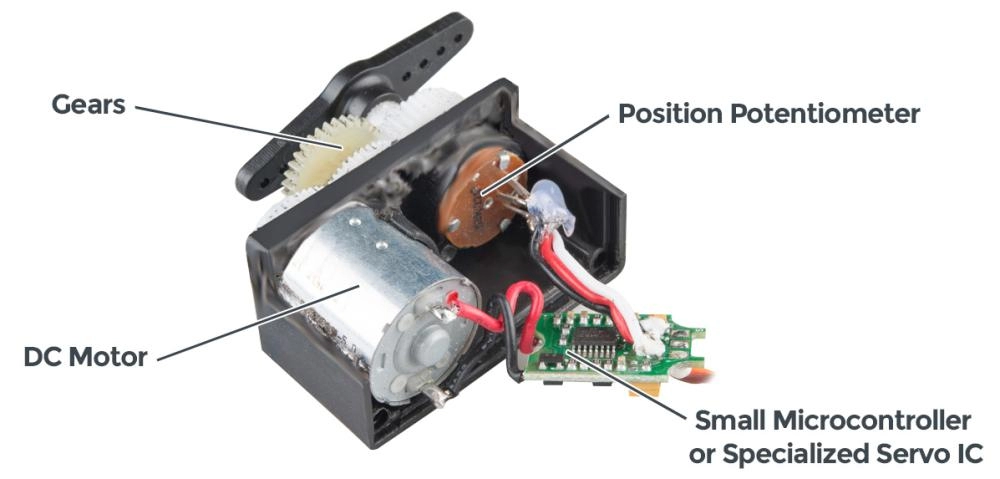
A servo motor, in simple terms, is a motor with precise control over how far, how fast, and how strongly it moves. Power is supplied through a servo amplifier (servo drive), which takes control signals from a PLC or motion controller and converts them into the exact voltage and current the motor needs.
At its core, the servo motor delivers torque or linear force to a mechanical system while constantly adjusting based on feedback from an encoder or sensor. This closed-loop control is what makes servo motors ideal for CNC machines, industrial robots, packaging lines, and high-speed positioning in factories worldwide.
For most of our global customers, the key fundamentals are:
- Servo motor – generates rotational or linear motion
- Servo amplifier – controls power and motion profile
- Feedback device – reports the exact position and speed
- Controller/PLC – sends motion commands and coordinates axes
In industrial automation, pairing a high‑quality servo motor with a reliable PLC motor control system is standard practice for stable, repeatable performance. If you’re building or upgrading a motion system, you’ll want a matched set of servo motors, drives, and controls, often integrated with professional PLC motor control solutions to keep everything synchronized and safe.
ELI5: What is a Servo Motor? (Simple Definition)
A servo motor is basically a motor with a built-in position sensor and tiny controller, all in one package. You don’t just tell it “spin”; you tell it exactly where to go, and it automatically moves to that position and stops.
Think of it like this:
- You say: “Turn 39 degrees.”
- The servo motor checks its position sensor.
- Its internal controller keeps adjusting the motor until it reaches exactly 39°, then holds that spot.
That’s why servo motors are everywhere in robots, CNC machines, camera gimbals, drones, and automation—they move to precise angles or positions, repeatably and reliably.
In industrial setups, this same idea is scaled up with servo drives and feedback encoders. For example, pairing a servo with a high‑speed CNC servo driver ensures ultra‑accurate motion control in high‑performance CNC systems, which is exactly what many of our global customers look for in precision manufacturing.
Basics: Structure and components of a servo motor
A servo motor is built around electromagnetism: a magnetic field generated inside the motor pulls a rotor into motion and lets us control that motion very precisely.
Main components of a servo motor
- Electric motor (core drive)
The DC or AC motor creates rotation using electromagnetic fields. This is what actually spins the shaft.
- Rotor and stator
- Rotor: the moving part connected to the output shaft.
- Stator: the fixed part with coils that create the magnetic field.
- Feedback device (encoder or sensor)
A position sensor (often an encoder or resolver) constantly reports the shaft position back to the controller so the motor can correct any error in angle or speed.
- Servo controller / drive (servo amplifier)
The servo drive compares the command signal (where you want the shaft to be) to the feedback (where it really is) and adjusts voltage and current to the motor in real time.
- Gearbox (in many hobby and industrial servos)
A compact gear train increases torque and limits the rotation range for tighter position control.
- Housing and connectors
A rigid housing keeps the components aligned and protected, while industrial systems often plug into PLCs like a Siemens SIMATIC S7‑1200 CPU for tight motion control.
This combination of motor + feedback + controller is what makes a servo motor ideal for CNC, robotics, and automated lines where exact position and smooth motion really matter.
Basics of Servo Motor Technology
A servo motor is a specific kind of electric motor built for precise, closed‑loop control of position, speed, and acceleration. Instead of just spinning freely like a regular motor, a servo works as part of a control system:
- Motor – generates the torque.
- Feedback device (encoder or resolver) – constantly reports the shaft position or speed.
- Servo drive / amplifier – compares the command signal to the feedback and adjusts power in real time.
This feedback loop is what lets a servo motor move to an exact angle, hold a position under load, or follow complex motion profiles with high accuracy and repeatability. In modern CNC machines and industrial robots, a servo amplifier such as a Fanuc α-series servo amplifier spindle drive works with the servo motor to deliver fast response, tight control, and stable operation even in demanding Global production environments.
Servo Motor Simple Definition
A servo motor is a compact rotary actuator that lets you control the exact angle of its output shaft. In simple terms: you tell it what position to go to, and it moves there accurately and holds that position.
What Is Inside a Servo Motor?
A standard servo motor system is made up of three main parts:
- Motor – usually a small DC or AC motor that provides the rotation.
- Feedback system – typically an encoder or potentiometer that tells the system the current position.
- Controller (servo driver) – compares the target position with the actual position and adjusts the motor until they match.
Because of this built‑in feedback loop, servo motors offer:
- Precise angular position control
- Stable holding torque at a set position
- Fast, accurate response, ideal for CNC, robotics, and packaging lines
If you work with CNC or industrial automation, you’ll often see servo motors paired with systems like GE Fanuc CNC controls in high‑precision setups, similar to what we support in our GE Fanuc motion control range.


 by
by